
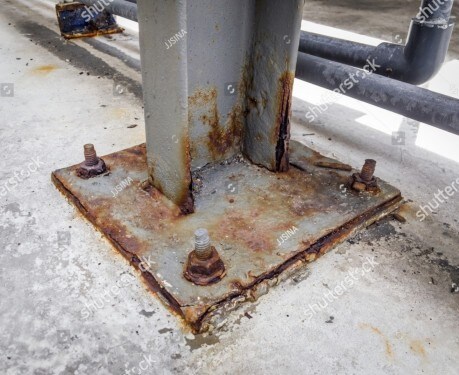
Why and how corrosion occurs
Corrosion is a ubiquitous, natural process. Most of us, at some point in our everyday lives, become familiar with the effect that corrosion has on rusted steel parts. Corrosion can have a huge economic impact. Almost up to a fifth of the world’s annual steel production goes towards simply replacing steel parts damaged by corrosion. For fastening systems, it’s even more critical as safety is key. Failure due to corrosion may have dramatic consequences. Despite this high awareness and high cost, corrosion’s effect on anchors is not always fully considered during the design process. As we go deeper in the topic you will see the inevitability of corrosion on steel anchorage systems, and thus gain an understanding of the importance of proper advance determination of fastening solutions.
We introduce this topic in three articles, including this one:
- Part 1: What is corrosion and the most common types of corrosion that can impair your steel plate fastening
- Part 2: General overview of corrosion systems and recommendations on how to select the right corrosion protection for anchors
- Part 3: Dealing with fastening in the presence of chemical substances
What is corrosion?
Corrosion is the physicochemical interaction between a metal and its environment, which results in changes in the metal’s properties and which may lead to significant functional impairment of the metal, the environment, or the technical system of which they form a part (see ISO 8044:2010). We only talk about corrosion when there is a change in the metal’s or system’s properties which may lead to an undesirable outcome.
This can range simply from visual impairment to complete failure of technical systems that can cause great economic damage and possibly even present a hazard to people. With the metals commonly used in engineering, such as carbon steel, stainless steel, zinc, copper and aluminum, the typical corrosion process can be regarded as the reverse reaction of the metal production from the respective ores (see figure below).
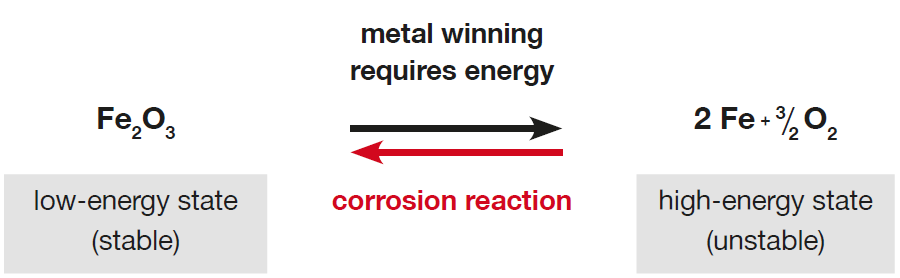
Chemical reactions of iron during corrosion and the metal-winning process
Types of corrosion reactions
Like all chemical reactions, corrosion processes take place when conditions are in favor of the related chemical reactions (thermodynamics). Other factors drive the speed of the reaction (kinetics). We will make a distinction between the common types of corrosion, generally describing the interaction between the metal and the environment, and forms of corrosion describing their most common appearance.
The most common corrosion reaction is electrochemical in nature. Such reactions imply an electrical exchange by way of electrons in the metal and ions in a conducting electrolyte, such as a water film on the surface of the metal.
The reactions can take place on the metal surface in a homogenous distribution leading to a uniform attack or can occur locally and separately, leading to localized forms of corrosion, such as pitting corrosion. The nature of the corrosion reaction results in the following necessary requirements for corrosion to take place:
- a conducting metal
- an electrolyte (a thin moisture film on the surface is enough)
- oxygen for the cathodic reaction
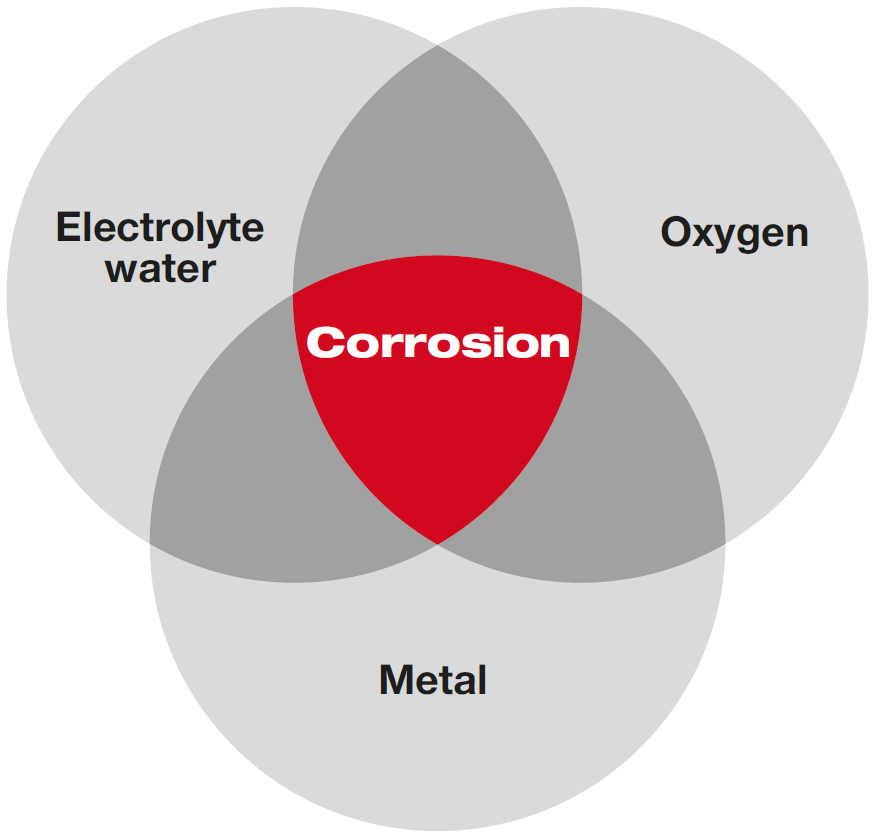
Requirements for the atmospheric corrosion reaction.
Form of corrosion 1: Uniform corrosion
Uniform corrosion is a form of corrosion where the surface is corroding almost evenly. The partial reactions (metal dissolution and oxygen reduction) are statistically distributed over the surface, leading to more or less homogenous dissolution of the metal and uniform formation of corrosion products (e.g. red rust on steel). The extent of this form of corrosion can usually be well estimated based on previous experience. The rate of corrosion is usually given in micrometers per year (μm/a). Using these average values, it is possible to calculate the life expectancy of a component, and thus to enhance its life expectancy by increasing its thickness. Uniform corrosion takes place, for example, on unprotected carbon steel and on zinc-coated steel under certain atmospheric conditions.
A pure homogenous corrosion attack is rare and unlikely to evenly attack an entire surface. There are usually areas, especially on complex metal parts, which will generally corrode faster than other surface, leading to a rough surface and irregular covering with corrosion products (e.g. rust on steel)
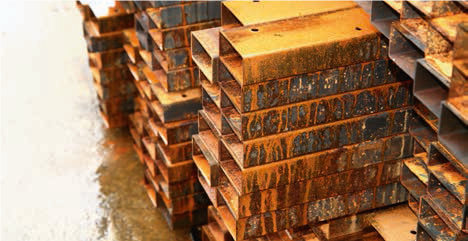
Corrosion of steel components
Form of corrosion 2: Pitting corrosion
Pitting corrosion is a localized form of corrosion that leads to the creation of small holes or “pits” in the metal (see Fig. 5). This form of corrosion is mainly found on passive metals. Passive metals and alloys, such as aluminum, titanium and stainless steel owe their corrosion resistance to a thin oxide layer on the surface with a thickness of only a few nanometers. The corrosion initiating process starts with a local break-down of the passive layer. A local corrosive attack can be initiated on stainless steels, for example, by chloride ions. Pitting corrosion can be quite problematic. Whereas uniform corrosion can be seen clearly on the surface, pitting corrosion often appears only as small pinholes on the surface. The amount of material removed below the pinholes is generally unknown, as hidden cavities may form, making pitting corrosion more difficult to detect and predict. Technically, there is no reasonable way to control pitting corrosion. This form of corrosion must be excluded right from the start through design considerations and use of the right material.
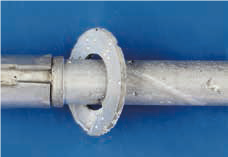
Example of pitting corrosion on a stainless-steel product
Form of corrosion 3: Galvanic (contact) corrosion
Galvanic corrosion refers to corrosion damage where two dissimilar metals have an electrically conducting connection and are in contact with a common corrosive electrolyte. In the electrochemical model of corrosion, one of the two partial reactions (anodic metal dissolution and cathodic oxygen reduction) takes place almost exclusively on one metal.
Generally, the less noble metal will be dissolved (anodic metal dissolution), whereas the more noble part is not attacked by corrosion (serves only as the cathode for oxygen reduction). Where galvanic corrosion takes place, the rate of corrosion of the less noble metal is higher than it would be in a free corroding environment without contact with another metal.
A positive example of active utilization of the galvanic corrosion phenomenon described here is the way zinc coating protects carbon steels and low-alloyed steels. Zinc is the less noble metal that actively protects steel by being corroded itself. An example: the carbon steel expansion anchor HST3 is a zinc-coated fastening solution.
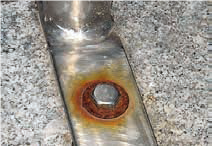
A typical case of contact corrosion. Zinc-plated carbon steel
(washer) and stainless steel (screw and part) were used together. The surface area
of the more noble metal – the stainless steel – is larger, causing strong corrosion of
the washer.
If you are dealing with corrosion and need support, just leave a comment, ask for advice in the forum section and download the Corrosion handbook for further guidance.