
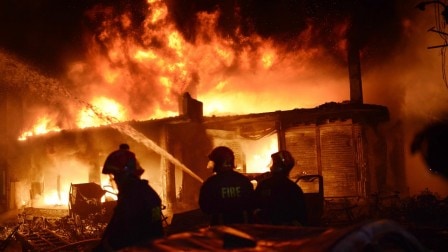
Fire Protection is a critical consideration for all those who are responsible for creating the design, specifications and construction of a building. It also has to be considered in the ongoing maintenance of occupied premises.
If you would like to learn more about related topics, do not forget to Register to Ask Hilti!
Active And Passive Fire Protection
Effective fire control within a building is generally achieved through a combination of active and passive fire protection systems.
Active fire protection systems are designed to react to the outbreak of a fire which is then suppressed with the help of alarm systems, sprinkler systems, suppression systems, fire extinguishers or other proactive mechanical systems. These systems require special energization or a command signal to operate. Special detectors are needed or, in addition, these systems will usually be operable by manual triggering from a control room or fire alarm call point. These systems also need massive backup systems, like a complete water supply system in the case of sprinklers which makes active systems vulnerable.
To balance and compensate potential weaknesses of these active systems, the need of passive fire protection is obvious. These systems are integrated in the structure of a building, restricting the spread of fire to a defined fire compartment that is composed of fire rated walls, floors or ceilings. They enhance the fire resistance. These systems are called passive because they do not need any special energization or command signal to operate. It is essential that these measures will work if an emergency occurs.
Firestopping is defined as a passive form of fire protection by protecting voids or openings created in fire rated walls, floors or ceilings. Firestopping is designed to keep the fire contained to a certain area and to minimize the amount of smoke that travels throughout the building.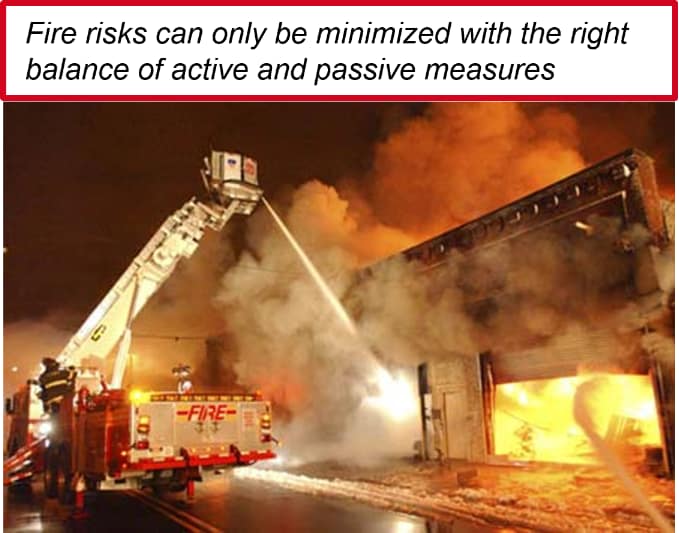
The fire safety of many modern buildings is now engineered via a fire safety strategy that encompasses active fire protection, passive fire protection, fire safety management and other measures. In such buildings, the active and passive fire protection measures work holistically to provide a fire safe environment1.
How fire works
Three things must be present and happen for a fire to break out (commonly known as the fire triangle):
· There must be a source of heat or ignition (flames)
· There must be fuel available (wood, paper)
· There must be oxygen (air)
In a closed room a fire develops in three phases: origin, development and extinguishment.
Origin: in this phase the three factors in the triangle of fire exist in a type of reciprocal relationship, depending of the fuel present. The fire begins and the amount of flammable material contributing to the fire expands, generating a great amount of smoke and a temperature increase.
Some fires start off very slowly, do not produce very much heat, but can produce very toxic smoke. Smouldering fires are very dangerous as well as they may suddenly turn into real flames and grow very rapidly.
Fires in a building can start in a number of ways. Most of the reasons are very unpredictable and precisely make clear that they can happen anytime, anywhere. These include:
· Faulty wiring or electrical equipment
· Careless use of ignitable material (lighters, cigarettes)
· Unsupervised or uninspected, poorly serviced heating, ventilation equipment
· Hot work
· Damaging natural disasters (lightning, seismic events)
· Self heating of specific materials
· Electrical sparks, short circuits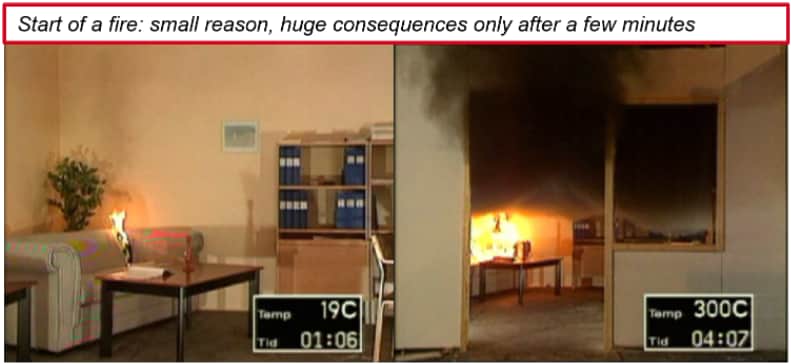
Development: the beginning of this phase of a fire is characterized by a so-called flashover. This is the spontaneous combustion of the existing flammable materials contained in a closed room. This occurs if the room temperature is between 1100°F and 1400°F. The timeframe for a flashover depends on the speed of the spread of the fire and can vary between 3 (!) and 15 minutes. The temperature then rises as high as approximately 1800°F.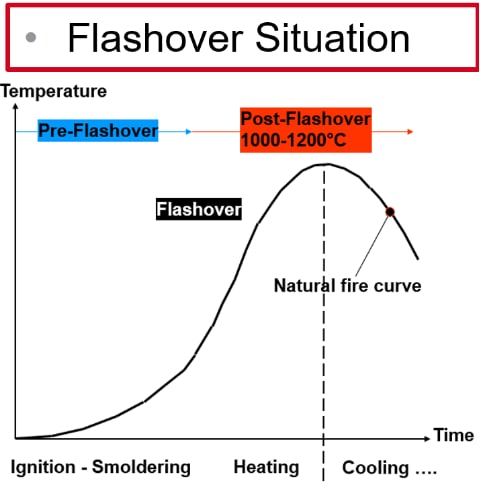
Extinguishing: as the flammable material is consumed, the temperature drops. Once all flammable material has been burned, the flames burn out or are extinguished. The fire can also be stopped by the removal of oxygen or by cooling the room through extinguishing measures.
For more information related to passive fire protection, check out our latest webinar about it!
Do not forget to read Part - 2 of the article!
Sources:
1) ASFP, Ensuring best practice for passive fire protection in buildings
Pictures: Hilti AG internal