
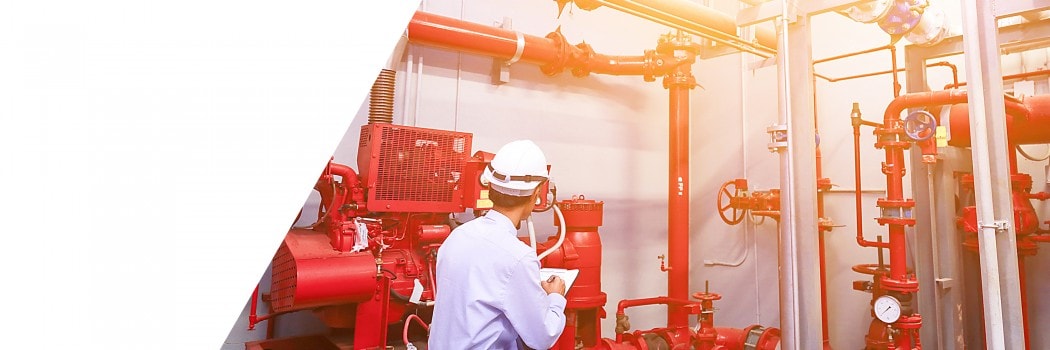
Fire Protection is a critical consideration for all those who are responsible for creating the design, specifications and construction of a building. It also has to be considered in the ongoing maintenance of occupied premises.
If you would like to learn more about related topics, do not forget to Register to Ask Hilti!
We would strongly advise to check the Part - 1 of this article before reading this piece.
The role of firestopping
Firestopping is basically very simple and follows exactly the logic of a fire. Firestop systems have to be tested according to strict test standards. This safeguards the functionality of a system and gives a clear indication to the designer and installer that the respective firestop product is a reliable solution passive fire protection measure.
The expectations to firestopping are very high. A firestop product has to withstand the high thermal and mechanical pressures that apply during a fire and maintain the necessary functionality to stop the spread of fire and smoke.
As there are many interdependencies and many different criterias to be considered (like wall and floor materials, different penetrants like cables, burnable pipes, steel pipes or insulation materials) the fire testing as such is a huge challenge for manufacturers. Therefore, designers and construction responsibles are asked to take this topic very serious and only rely to established and recognized manufacturers with longterm market experience, dedicated resources for testing and development and professional accredited quality and production control systems. The risk of a fire shall never be underestimated.
Firestopping terminology
It is important to at least have a basic knowledge of some terms and expressions which are important to judge a firestop system and its field of application.
Stability: a measure of the structural stability of a component in case of fire.
Integrity (referred to as F-rating or E rating): a measure of the ability of a component to prevent through openings or the penetration of flames in case of fire
Insulation (referred to as T-rating or I rating): a measure of the insulation properties of a component. This means the it takes for any point of the side of the component, facing away from the fire, to reach a temperature of 325°F of the ambient temperature. It is also called heat conduction.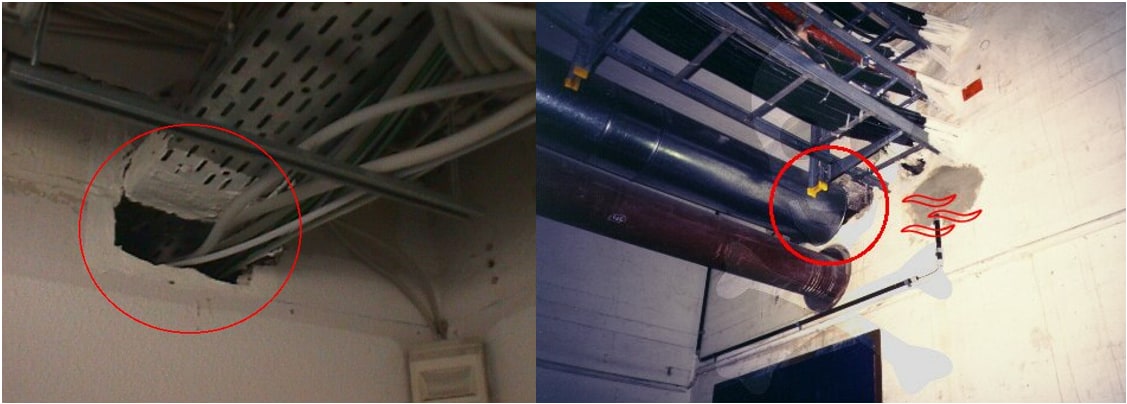
Practical examples: penetrations through fire rated compartments provide insulation and integrity…only if firestopped properly.
Time-temperature curve: standard test methods require that the air temperature within the testing furnace ramp up to a specified temperature within a specified amount o time, and then maintain that temperature for a specific period of time. This is done to simulate the phases of a fire in controlled environment. Therefore a specified ISO temperature curve has to be followed for each test.
Compartmentation: fire and smoke compartments are to limit the spread of fire and to provide evacuation paths for people in the building. Compartments also protect assets in neighbouring rooms, hallways or facilities. And, very important, compartments protect the spread of socalled “cold” and toxic smoke. This is one of the key killers of a fire and must be seriously considered for all firestopping systems as many active fire protection systems (like sprinklers, heat detectors) do have significant weaknesses respectively do not function.
Basic situation – often underestimated by building owners and designers
An uncontrolled fire can quickly become a danger for people and property. Firestopping is generally aimed at combating the undesired characteristics of a fire. In spite of numerous regulations and precautions, the outbreak of fire can never be throroughly and securely prevented. Common sense and the careful handling of possible sources of danger remain the most significant protective measures.
Applications for firestopping can range from walls, floors and ceilings. In basically all building types, these applications are manifold. 
Firestop applications: cable and pipe penetration, joints
Cable penetrations: this area is a very typical problem area. Configurations range from single cables, cable bundles to heavily loaded cable trays or ladders. Cables also come in burnable plastic conduits. Cables consist of different plastic materials (insulation), rubber and copper. Components which burn, melt, transfer heat and develop toxic smoke. Heavy cable penetration systems also endanger the mechanical stability of a fire rated through-penetration application in case of a fire.
Pipe penetrations: this application area is very diverse and implicates many practical problems. One can mainly separate this application into two main topics: plastic (burnable pipes) and metal (non-burnable pipes). Burnable pipes melt and burn away and leave a hole through which heat, fire and smoke can travel. Special firestop devices like firestop collars with intumescent inlay material which expands when confronted with fire closes the opening and reinstates the fire integrity. Metal pipes transfer significant heat from one compartment to the next and increases risks of ignition of combustable material. Most pipes are insulated respectively have to be insulated to avoid fire risks. Different insulation materials also define respective firestop solutions and have to be considered for proper firestop functionality. Pipe movement (seismic, vibration or temperature movement) should also be considered choosing specially tested pre-engineered products.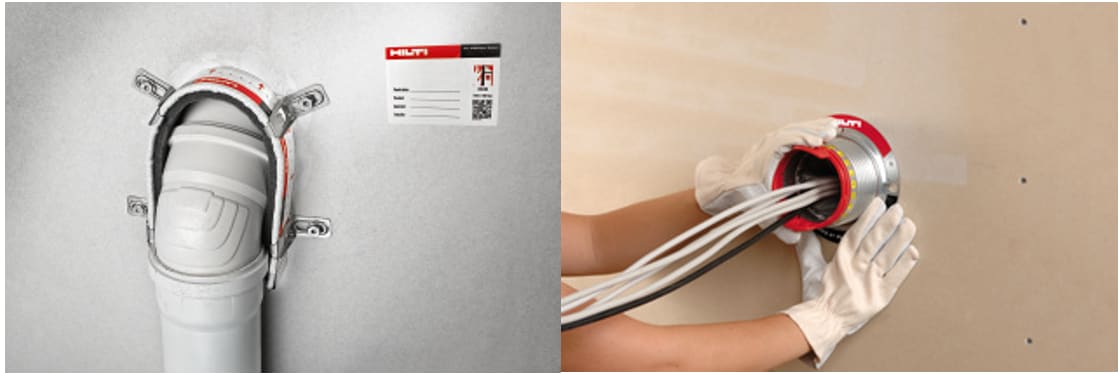
Hilti Firestop products offer many additional advantages for planners and facility owners.
Construction joints: joints between walls, floors, or wall to floor represent the third application area. The main problem is cost of installation as specific joints are quite complex fo fire seal. A typical example is the top-of-wall joint between a drywall construction and a floor. Movement, acoustics and ease of installation are challenges. Hilti for example provides easy to install pre-designed top track seal system CFS-TTS which offers many inherent properties and which can be easily specified and designed. Another crucial joint type is the perimeter or curtain wall joint. Recent fires of highrise buildings and skyscrapers showed the dramatic consequences of fire, heat and smoke transfer from one floor to the next floor on the edge of slab. Special spray solutions cover many of the existing risks of this type of joint applications, like the Hilti Firestop Joint Spray CFS-SP WB. Special tests prove reliability and functionality in curtain wall joint applications.
Example of two cost efficient easy-to-specify firestop joint solutions: Hilti Firestop Spray and Hilti Firestop Toptrack Seal
Planning of firestop
Firestopping therefore is an important, if not one of the most effective measure to contain a fire, limit the spread of smoke and therefore saving lives and protecting assets. It is an easy to integrate and design topic.
The fact that firestop is poorly considered in the planning and budgeting phase of a construction project, is one of the most hidden risks in existing buildings. Proper firestop planning is critically important since the risk areas are often located in concealed spaces which means that fire can pass unnoticed. It also makes evaluation of the correct installation difficult. Most other problems during construction (change requests, coordination issues between different trades resulting in cost increases for fire protection) and during building approval (inspection, quality of installation, usage of unapproved systems) can be easily avoided if the topic of passive fire protection is taken into account already in an early planning stage. 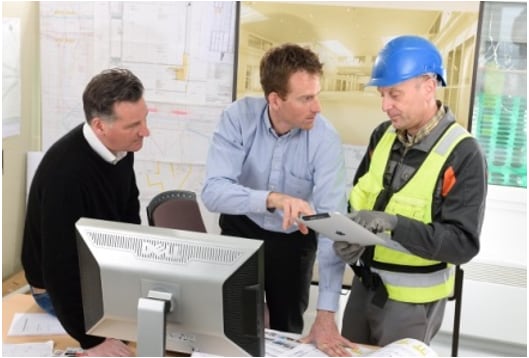
Pre-planning of passive firestop: the key to a safe building for occupants and assets
Manufacturers, like the the global market leader Hilti, provide design typicals, specification clauses and internationally tested and approved and innovative firestop systems, that not only provide a wide field of application. They also offer added value for planners, building owners. Hilti firestop products are designed, tested and approves and as a specialty consider important properties: pre engineered devices for easy inclusion in design plans and specifications, proper installation, easy inspection and important facility maintenance features like retrofitting or additional attributes which consider movement, acoustics or resistance to mold and mildew when it comes to the lifetime of a building.
Hilti is the global market leader in firestopping. Our dedication to stringent testing and code developments help make buildings safer today, saving lives and protecting asset, with proven reliability and outstanding service.
Hilti, with own worldclass research and development is committed to supply easy-to-use firestop solutions, providing cutting-edge and fully integrated and tested systems. At the end of the day, together with a unique professional technical support in many countries, this helps specifiers and installers to correctly select the right system for the right application and also to correctly specifiy compliant and tested solutions.
Sources:
1) ASFP, Ensuring best practice for passive fire protection in buildings
Pictures: Hilti AG internal
