
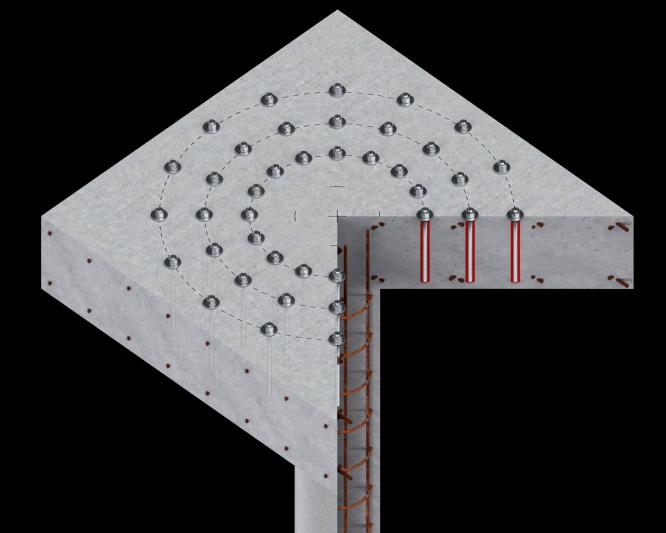
Searching for effective methods to strengthen concrete deficient in punching shear? Hilti has you covered.
INTRODUCTION
Over the past 20 years, the construction industry has faced growing pressure to reduce its environmental impact and reuse existing structures, especially in urban areas where many reinforced concrete buildings and bridges are nearing the end of their service life. Strengthening these structures is often preferred over demolition due to factors like changes in use, building expansion, updated codes, and structural deficiencies. When feasible, strengthening can offer significant benefits, including faster turnaround times (15–70%) and reduced resource consumption (10–75%), which positively affect environmental and financial outcomes. The decision to strengthen versus rebuild depends on structural condition, client needs, and the building’s cultural or societal value.
STRENGTHENING CONCRETE SLABS AND FOUNDATIONS DEFICIENT IN PUNCHING SHEAR
When a building changes from office to commercial use, the increased footfall results in higher loads on the structure, particularly on the floors. An engineer’s assessment may reveal that the existing flat slab lacks adequate capacity—often in punching shear, bending, or both—necessitating strengthening to ensure structural safety. Recall that in most design standards, such as Section 6.4 of EN 1992-1-1:2004 [2], the resistance of a concrete member in punching shear depends on the following five parameters:
1. Concrete strength,
2. Effective depth to the flexural reinforcement from the top of the compression fibre,
3. Size of the support and the control perimeter
4. The amount of longitudinal reinforcement
5. The amount of punching shear reinforcement
Employing a range of potentially available “local”-level solutions to improve one or several of these parameters enhances punching shear resistance by varying amounts, yet this incurs a trade-off in terms of invasiveness, cost, availability, and other parameters. Some modifications may not be even feasible, such as increasing the concrete strength of an existing beam. Others, such as adding more supports through additional columns to reduce punching shear demands will require load transfer to the foundations. Therefore, the Hilti range of solutions to enhance parameters (1) to (5) is summarised in Table 1:

Table 1: Potential solutions to strengthen concrete deficient in punching shear
POST-INSTALLED PUNCHING SHEAR REINFORCEMENT TO INCREASE RESISTANCE
In recent years, the development and sufficient maturity of post-installed anchoring technology have led its use in applications beyond steel-to-concrete fastenings and concrete-to-concrete connections. One use in strengthening is in concrete overlay where both bonded and mechanical fasteners function to reinforce the interface between the existing and new concrete. More details on strengthening with Concrete Overlays can be found in the Concrete-to-Concrete handbook [3] or in the dedicated Whitepaper [4].
Another use of the bonded anchor system in strengthening is in a recently developed Hilti strengthening solution “HIT-Punching Shear” which directly increases the resistance to punching shear loading of reinforcement concrete members, as illustrated in Figure 1, akin to cast-in stirrups.

Figure 1: Hilti HIT-RE 500 V4, HAS(-U) rods, and filling set used as post-installed punching shear reinforcement
This solution is installed in a similar way to a bonded anchor: i.e., drilling to a fixed embedment depth perpendicular to the concrete surface, thoroughly cleaning the debris from the boreholes, and injecting the mortar and then inserting the rods. Once the mortar cures, the nuts can be torqued up to a maximum specified value.
Note: Unless explicitly considered in design, drilling and cutting through the flexural reinforcement should be avoided wherever possible to prevent further weakening of the structure. If this cannot be avoided, for instance to facilitate drilling in densely reinforced areas, additional measures with the explicit agreement of the Engineer-in-Charge of design are required to compensate for a loss of flexural reinforcement.
NEW HILTI “HIT-PUNCHING SHEAR” STRENGTHENING SOLUTION
The new Hilti HIT-Punching Shear strengthening solution consists of the following components:

Figure 2: The Hilti HIT-Punching solution
The solution pairs the HIT-RE 500 V4 injection mortar with Hilti HAS series of threaded rods in sizes M12, M16, M20, and M24, each available in carbon- and stainless-steel for indoor or outdoor use. The steel elements are completed by the Hilti Filling Set that consists of a sealing and spherical washer, a nut, and an optional locknut, also available in both carbon- and stainless-steel for each rod diameter.
The versatility of this system covers the following parameters:
- Slab thickness between 200-1100 mm, with a minimum effective depth of 160 mm.
- Installation from top or bottom side of the slab with defined rod length ranges as function of the slab thickness and rod diameter.
- Concrete strength between C20/25 & C50/60.
- Dry or water-saturated concrete, and in waterfilled holes.
- Maximum short- and long-term temperatures of +40°C and +24°C, respectively.
- Members subjected to static and quasi-static loading.
FLEXIBILITY IN YOUR HANDS – LEVERAGE THE POWER OF PROFIS ENGINEERING
Hilti’s cloud-based design software PROFIS Engineering includes a new dedicated module for assessing and strengthening concrete members deficient in punching shear that assists structural engineers when evaluating the resistance of existing members and strengthening them, thereby ensuring a safer and more efficient workflow. The new PROFIS Engineering Punching Shear Strengthening module enables:
- Selection between rectangular and circular column, wall ends, and wall corners on slabs and definition of its material properties & geometry.
- Verification of the existing concrete’s resistance to EN 1992-1-1:2004.
- Strengthening according to aBG Z.15-5.387 [5] in conjunction with DIN EN 1992-1-1/NA:2013, with a choice of 4 reinforcing diameters in carbon or stainless-steel & free input for the spacing and edge distances.
- Free manual input of the radial spacings and the number of strengthening elements in each perimeter.
- Generation of a comprehensive design report with all verifications, reinforcement detailing, and installation instructions.

Figure 3: PROFIS Engineering screenshot
SUMMARY
Transforming and reusing older structures can offer many advantages over new build ones, with each structure requiring fulfilment of specific objectives when strengthened. Based on the chosen design philosophy, the structural engineer can address punching shear deficiencies in slabs and foundations through various methods, some less invasive than others. The use of post-installed punching shear reinforcement, such as Hilti’s solution of HAS(-U) threaded rods with the HIT-RE 500 V4 mortar, is a novel example of a minimally invasive method that can significantly enhance the punching shear resistance of a structural member.
Suitably assessed and granted a general construction technique permit (aBG) as a system by DIBt, engineers can use a familiar Eurocode 2-based design approach integrated into Hilti’s PROFIS Engineering Suite to arrive at a feasible solution by selecting between the key design parameters such as diameter and spacing. With an intuitive interface, the new Punching Shear Strengthening module assists engineers by saving time during the design phase, bringing value to their clients while also contributing to a safer and more resilient built environment.
To know more, refer to our Whitepaper [4] that expands on this article.
To start designing, visit https://profisengineering.hilti.com/
REFERENCES
1. N. Addy, “Making sustainable refurbishment of existing buildings financially viable”, in Sustainable Retrofitting of Commercial Buildings - Cool Climates, S. Burton, Ed., Abingdon, Routledge, 2015, pp. 57-73.
2. EN 1992-1-1:2004: “Eurocode 2 - Design of concrete structures - Part 1-1: General rules and rules for buildings”, Brussels: CEN, 2004.
3. “Concrete-to-Concrete Connections Handbook”, Hilti AG, Liechtenstein, May 2024.
4. “Whitepaper on Shear-friction Applications and Concrete Overlays”, Hilti AG, Liechtenstein, Dec. 2023.
5. Deutsches Institut für Bautechnik, “Z-15.5-387 - Hilti Durchstanzverstärkungssystem mit Hilti HIT-RE 500 V4”, DIBt, Berlin, 2025.
